
Your Flaws Are Fuel
What If [What's Wrong With You] Is [What's Best About You]

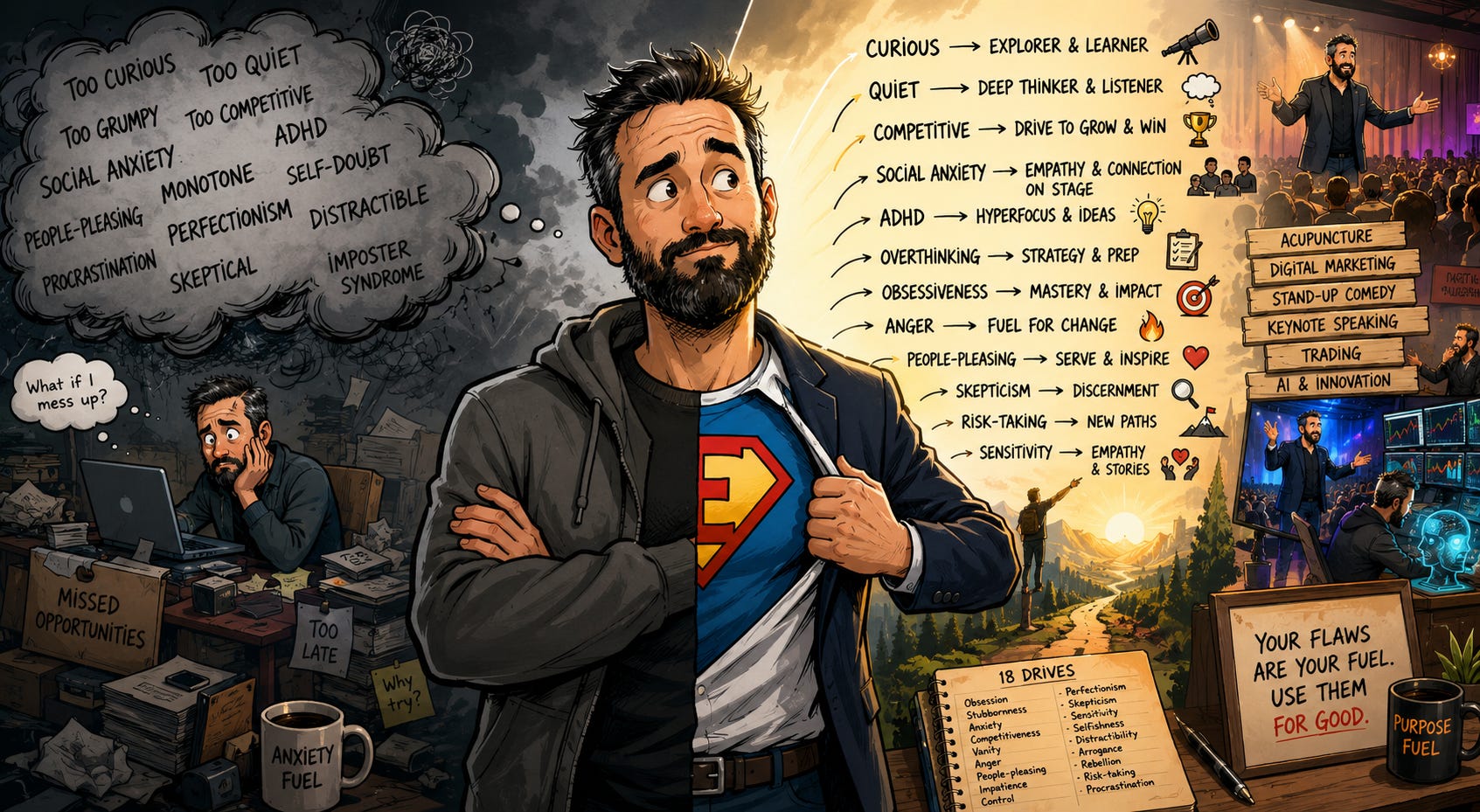
For most of my life, I and the world had a list of things wrong with me.
He’s too quiet. When he isn’t he asks too many questions. He’s too grumpy. He’s weirdly competitive about stuff that doesn’t matter. He’s so anxious around people that he talks monotone and flat.
I got diagnosed with social anxiety and ADHD later in life, which explained about eighty percent of that list.
That diagnosis helped me realize every single one of those “problems” is a reason for my success.
Curious: I’ve had six careers — acupuncture, digital marketing, stand-up comedy, keynote speaking, trading, now AI.
Quiet: Only outwardly quiet. Plenty of talking going on inside. Ironically why I have 200-plus keynotes.
Grumpy: A strong sense of how things should be, and how I should be.
Competitive: My ambition, personal growth, drive to get the gig, make the sale. Why I try to be the best person I can.
Socially anxious: the thing that kept me from talking to new people and even fearing mixers well into my forties — the reason I felt normal onstage was I had always felt like I was onstage even when I wasn’t.
Here’s the idea…
Your flaws are your fuel.
The question is whether you’re using those flaws for good. Or just being ashamed of them.
This isn’t “fix your weaknesses” or “hustle harder.” It’s smarter:
Stop trying to change who you are. Enlist your “negative” traits to get what you want and become who you should be.
I’ve been thinking about 18 drives... negative traits that are really engines.
Obsessiveness. Stubbornness. Anxiety. Competitiveness. Vanity. Anger. People-pleasing. Impatience. Control. Perfectionism. Skepticism. Sensitivity. Selfishness. Distractibility. Arrogance. Rebellion. Risk-taking. Procrastination. (I’m sure there are more.)
You probably know which of those are yours.
I don’t know if this is a book yet. That’s why I’m posting this.
The plan is to write one of these a day for a year — a short story, the trait, the redirect. I’ve written a stack of them already. So instead of telling you what they’re like, I’m just going to give you one and let you decide.
Here’s the first.
---
The Enthusinator
For my first three speeches at Toastmasters, I was terrible.
And I don’t mean nervous-but-charming terrible. I mean monotone, lifeless, reading-your-own-obituary terrible. Not good. Monotone and boring. No vocal variety.
So why was I there? I had massive social anxiety. Terrified of groups. But I joined Toastmasters anyway — because I wanted to be a famous author one day. Who knows why- vanity? insecurity?
One guy there told me, “You’re really good at talking to people one-on-one. Just not in front of a group.”
I don’t know if he was a jerk, or just trying to challenege me, but I got mad and I got competitive: “I’ll show you!”
So for my fourth speech, I came up with this concept. I wore a dress shirt. Underneath — a Superman t-shirt with an “E” on it.
Started the speech the usual way. Monotone. Flat. “Hey. I’m Brian. This is my speech and I’m really excited to talk to you about it... um...”
Then I ripped the shirt open and started running around the room.
“I’M THE ENTHUSINATOR! How you doing? Get up! High five! YES! Jump around! We’re gonna do this! YEAH!”
It was stupid, ridiculous, and freeing.
I gave myself permission to be someone who wasn’t afraid of the room for five minutes. The Enthusinator didn’t care if people liked him. He was too busy being enthusiastic.
The irony — people liked The Enthusinator more than they liked me!
The thing I was so afraid of — rejection — was being caused by the thing I was doing to avoid it.
My anger told me something was wrong. My insecurity made me work on it. My competitiveness made me engineer something that blew away every other person’s speech- but more importantly, it made me grow in a way that improved my future value.
Because the Enthusinator came from me too, and now it was a validated way of being me in the world.
Fifteen years of professional keynote speaking later, I still read every room. I still notice the person in row three whose arms are crossed. I adjust in real time. That’s not some technique I learned at a conference. That’s social anxiety, redirected.
Anger gets a bad name because mostly we see people destroy things with it. Some people are absolutely terrified of anyone ever being angry. It’s forbidden. They police it.
But some people using their anger every day to fight injustice and right wrongs. They just don’t necessarily know, or admit, that that’s the fuel.
How many people have told you that anger can be a positive force?
Sure, it’d be ideal (we think) if their motivation were world peace or justice or fairness- and it might be- but I’d bet you that there’s a spark of anger underneath those positive values, and that the anger came first.
What are you angry about, and what are you going to do about it?
What are you anxious about, and how can you rise above it?
How competitive are you, and have you accepted that that’s ok?
---
Okay. That’s one example!
If you want 364 more of those, tell me. And more useful than that — tell me your drive. Go back to the list of 18 and reply with the word that made your stomach drop. I’m collecting these, because half the reason I want to write this is to hear how other people aimed the same engine somewhere I never would have thought of.
I’ll read every one.
— Brian