
Why Veteran Traders Are Scratching Their Heads in 2025
A newbie's observations on what's breaking the old playbook

Why Veteran Traders Are Scratching Their Heads in 2025
A newbie's observations on what's breaking the old playbook
As someone relatively new to the stock market, I've been watching experienced traders with fascination this year. These are people who've been crushing it for years, guys with decades of experience and battle-tested strategies. But 2025? They're having one of those humbling trading years. You know the kind – where their tried-and-true strategies suddenly feel like they're working against them instead of with them. After some serious reflection (and a few too many losing trades), many are realizing it's time to completely rebuild their indicator systems from scratch.
The Modular Approach: Building Blocks First
Here's what I've learned from watching the pros adapt: instead of trying to create one massive, all-encompassing indicator, the smart money is going modular. Create individual indicators for each strategy type first, test them separately, then combine the winners. It's cleaner, easier to debug, and honestly? Way less overwhelming.
So which strategy should they tackle first? The one that's been their bread and butter for years but is absolutely bombing in 2025.
Meet Their Former Champion: Reversal Systems
The usual suspects: RSI oversold/overbought signals, MACD crosses from extreme zones, Bollinger Band touches, divergence plays – you know the drill.
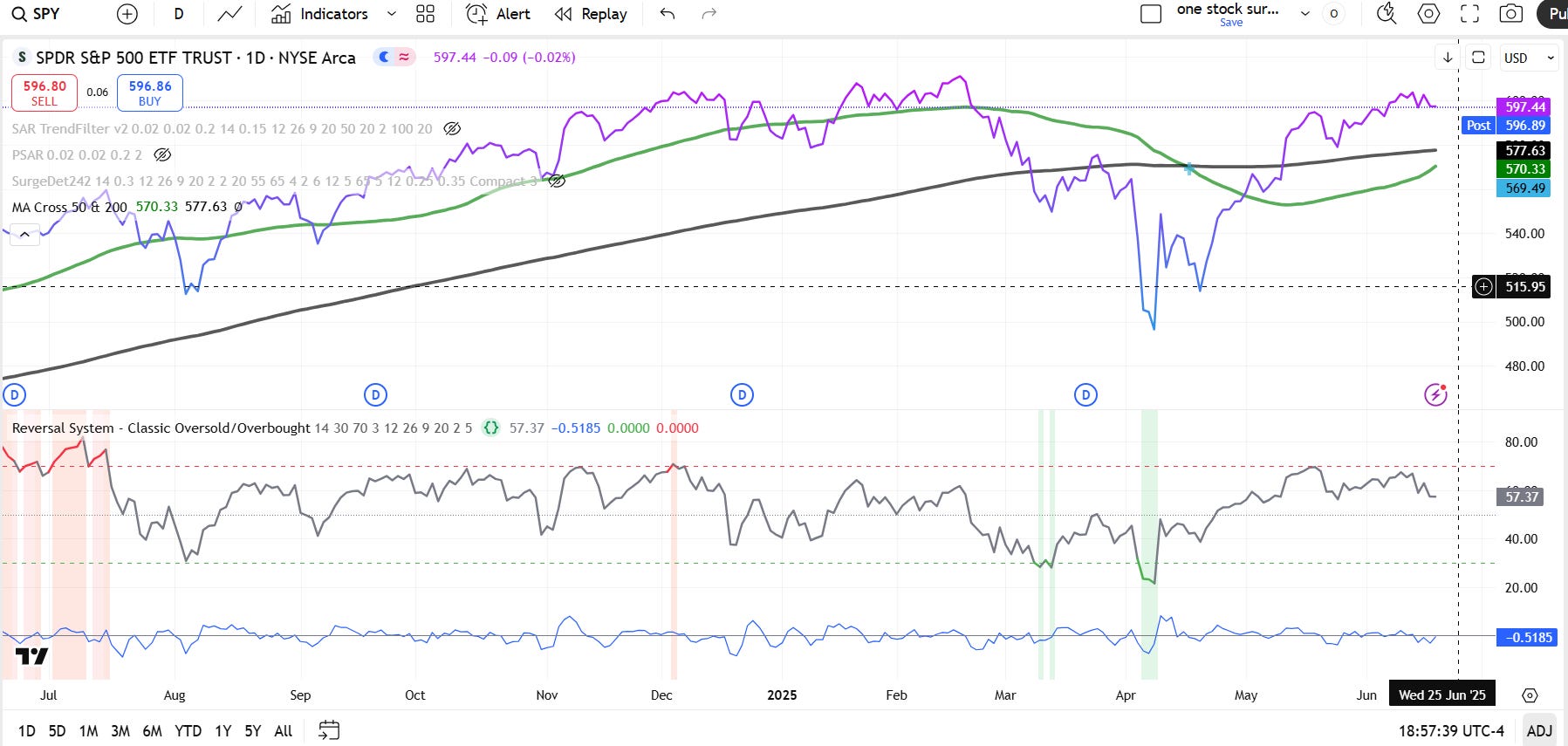
Why Reversal Systems Usually Dominate
For the longest time, these setups were the money makers for most experienced traders:
They catch exhaustion moves early. Nothing feels better than buying right at the bottom of a selloff
Perfect for range-bound markets. When stocks are bouncing between levels, reversals are like clockwork
They're popular for a reason. RSI and MACD are built into every platform because they work
Great risk/reward. You're buying fear and selling greed – what's not to love?
The 2025 Reality Check
But this year? It's been a different story entirely. Here's what's been killing the veterans' reversal plays:
Low volatility + shallow dips = Price rarely gets oversold enough to actually trigger their signals. When RSI finally hits 30, the "bounce" is maybe 0.5%.
Stealth rallies from nowhere = The real moves are happening when RSI is sitting in neutral territory. By the time they're waiting for their oversold signal, they've missed the entire run.
Sector rotation madness = They're watching the S&P 500 RSI waiting for a reversal while AI stocks are up 15% and everything else is flat. Index-level signals are missing where the actual money is moving.
This uptrend is relentless = "Buy the dip" setups are lasting about 30 minutes before new highs. Their reversal signals are catching falling knives in a market that barely dips.
Most of 2025's gains have come from:
Breakouts from tight, boring consolidations
Momentum moves that never reach traditional overbought levels
Mid-range technical patterns that reversal systems completely miss
What Makes 2025 So Different?
Watching the pros struggle this year has been fascinating because 2025 isn't just another tough market – it's systematically breaking patterns that have worked for decades. Here's what I've observed that makes this year so unusual:
The Sector Rotation Chaos
This might be the most telling sign: no sector has maintained the top position for more than two weeks in 2025. Think about that for a second. In normal markets, sector leadership usually lasts months, sometimes quarters. It gives experienced traders time to identify trends, position themselves, and ride the wave.
But this year? Tech was down over 6% while value stocks gained 1.89% and international stocks rocketed up 11.21% – all in the first quarter. Just as traders were positioning for a "great rotation" into value, the leadership shifted again. Technology stocks that returned over 36% in 2024 are down almost 5% in 2025, while basic materials – the worst performer in 2024 – are up 4.55%.
Traditional sector rotation strategies depend on being able to anticipate where the economy is in its cycle and positioning accordingly. But when leadership changes every two weeks, those playbooks become useless.
The Tariff Wildcard
April 2, 2025 marked what Trump called "Liberation Day" – when sweeping tariffs triggered the largest global market decline since 2020. But here's the kicker: less than a week later, Trump announced a pause on tariffs, leading to soaring stock prices and one of the largest single-day gains in years.
The average effective tariff rate is now over 15% – the highest since the late 1930s Great Depression era. But the policy keeps changing. The level and timing of tariffs have changed repeatedly since the April 2nd announcement, making it challenging to determine which sectors might benefit or be hurt by them.
How do you build a trading strategy around fundamentals when government policy can completely reverse overnight? This isn't normal market volatility – it's policy whiplash.
The Great Correlation Breakdown
Here's something that should terrify anyone who learned investing in the last 30 years: the correlation between bonds and stocks broke in 2022 and remains broken through early 2025. For the first time in over 30 years, growth, stocks and bonds went down together.
The entire 60/40 portfolio concept was built on bonds providing ballast when stocks declined. This relationship was considered an axiom in portfolio management. But when growth decelerates, stocks tend to correct, and bonds used to go higher every time since the year 2000. However, since 2022, this correlation broke.
Veterans who've relied on bonds as a hedge are finding themselves with nowhere to hide.
International Stocks Are Actually Winning
The first half of 2025 is a case study on why investors should consider international diversification, as U.S. stocks have underperformed international stocks so far this year. This is stunning because international stocks have been the "widow maker" trade for over a decade.
The Morningstar China Index is up 16.00% this year, compared with a 0.25% loss for the US Market Index. Even more surprising, UK stocks have performed well, even though many are concentrated in old-economy stocks like banks, energy, and pharmaceutical companies.
American exceptionalism in markets has been the dominant theme since 2010. But 2025 is forcing traders to completely rethink geographic allocation.
Factor Investing Is Broken
The low-volatility and yield factors were the best-performing factors globally, while quality and momentum struggled. This is backwards from everything factor investors have learned over the past decade.
Quality-factor companies like Nvidia, Arista Networks, and Alphabet – companies with really high profit margins and strong balance sheets – came into 2025 with really high expectations and sold off deeper than the market.
When high-quality, profitable companies with strong balance sheets underperform the market, you know something fundamental has shifted.
The New Reality
What I'm seeing from talking to experienced traders is that 2025 feels like the markets are operating under completely different rules. The old playbook of watching economic cycles, sector rotation patterns, and traditional technical indicators isn't just underperforming – it's actively harmful.
Markets are no longer priced for an adverse outcome, but risks remain on several fronts, and the sunnier the market's expectations, the harder it is to beat them. It's the ultimate understatement to say the first half of the year has been choppy for stocks.
The smart money is adapting by going modular with their approaches, building systems that can quickly adjust to whatever weird new pattern emerges next. I'm hearing about traders experimenting with five main approaches:
Structure & Regime Detection – Using SMA crosses, Donchian channels, and volatility measures to identify what kind of market environment they're actually in. Instead of assuming the market will behave a certain way, they're letting the market tell them what game is being played.
Volume-Weighted Momentum – Combining traditional momentum indicators like RSI and MACD with volume confirmation. The idea is that real moves need participation, not just price action. If momentum isn't backed by volume, it's probably a head fake.
Multi-Timeframe Confluence – Requiring signals to agree across multiple timeframes before taking action. A signal that looks great on the 1-hour chart but conflicts with the daily trend is probably noise. This helps filter out the false signals that are plaguing single-timeframe strategies.
Reversal Systems – Yes, they're still using them, but with much stricter criteria. Classic oversold/overbought levels, MACD crosses, and Bollinger Band touches, but only when multiple conditions align and the broader market structure supports it.
Mean-Reversion Volatility – Using Bollinger Band width, ATR, or VIX-like proxies to identify when volatility expands and then fades. Instead of betting on direction, they're betting on volatility returning to normal levels.
The key insight I'm hearing repeatedly is that no single approach works consistently in 2025. The successful traders are building systems that can quickly identify which regime the market is in and switch between these different approaches accordingly.
Because if 2025 has taught us anything, it's that the moment you think you've figured out the new normal, the market changes the rules again.
For someone new to investing like myself, watching this unfold has been both terrifying and educational. It's a reminder that even the most experienced professionals are constantly learning and adapting – and that maybe being new to this game isn't such a disadvantage when the old rules don't apply anymore.