
Sixty Hours Fighting Chocolate Cake
At 3 AM on the third day of my fast, I lost a staring contest with a dessert.

At 3 AM on the third day of my fast, I lost a staring contest with a dessert.
Let me back up.
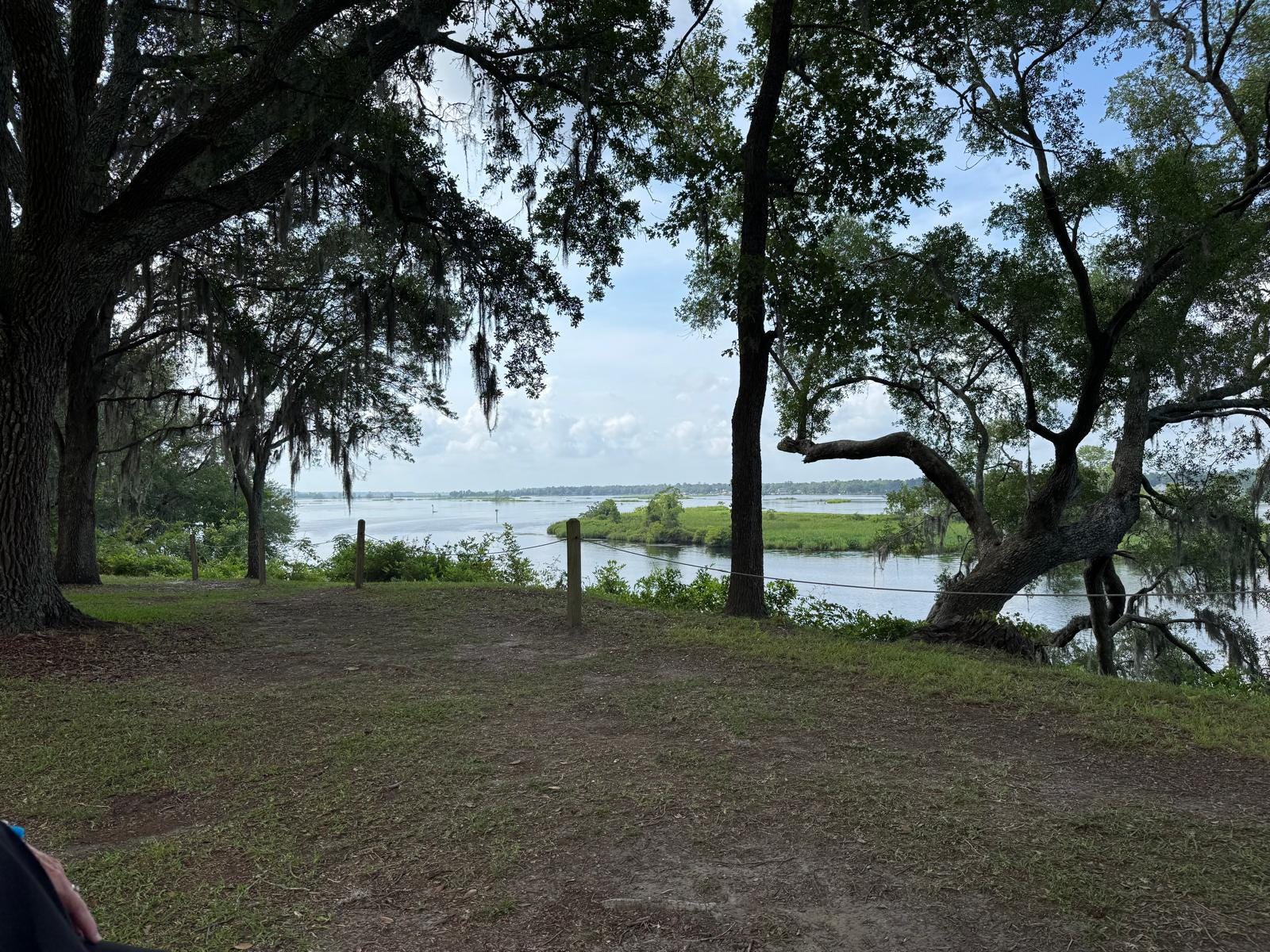
Every year since 2021, my mom and I go on an annual retreat to Mepkin Abbey, a Trappist monastery near Moncks Corner, South Carolina — a town named after a guy called Moncks, not the monks.
That kind of coincidence makes you think God has a sense of humor but it’s mostly puns. Father jokes not dad jokes.
Anybody can go. You don’t have to be Catholic. I’m not — I’m some homemade blend of Protestant, Buddhist, and Taoist, no dogma, no church, just a spirituality. You don’t have to pray with the monks, and they pray six times a day, so opting out saves you a lot of kneeling.
Really it’s a spiritual hotel. You get a room, silence, and surprisingly good vegetarian food, because right now they have an actual chef.
But lunch is the big meal, so if you roll in at dinner expecting the chef, you get peanut butter, jelly, and humility.
This year I went there to fast.
Two and a half days, water and coffee only.
And in the retreat center — the always-open room where you get your water and coffee — somebody had left a chocolate cake.
Two-Thirds Bad
Here’s a pattern I’ve noticed across fasting, regular retreats, and dark retreats, and I’ve done enough of all three to call it a pattern and not a coincidence: the first day, you’re adjusting. Then it gets hard. And it stays hard longer than you want — about two days, in my experience.
Day three is when it gets better.
Unless you wake up at 3 AM on day three, sixty hours in, and your entire soul says it’s cake time.
So I had coffee, ate the cake, added some cookies and a Reese’s-type situation on top, then sat in a chair waiting for the reflux I had absolutely earned.
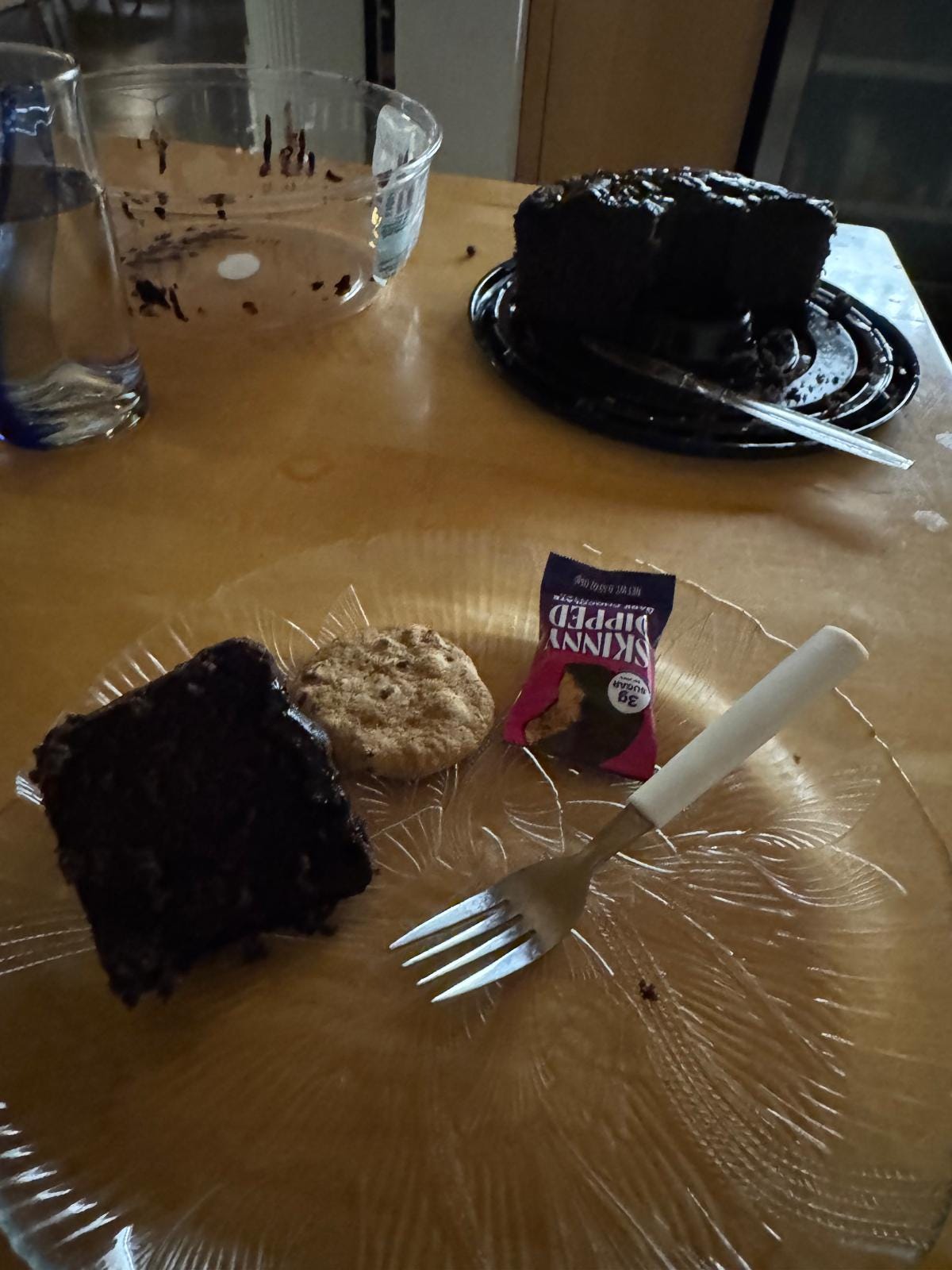
Sixty hours of discipline, undone in about four minutes. I’d feel worse about it, but one of the books I was reading that week had a story about a desert father — one of the original Christian hermits — who spent days alone seeking closeness to God and felt nothing. Then the retreat ended, and it hit him. After. On its own schedule.
That’s the actual lesson, I think. You can’t time the payoff. You can’t control it. You can’t even tell, in the moment, whether anything’s working. The only move you get is scheduling the difficult thing and showing up whether you feel like it or not — because you won’t feel like it. That’s not a flaw in the plan. That’s the plan.
It’s like exercising- it’s hard but afterwards you feel great.
Even if only because it’s over!
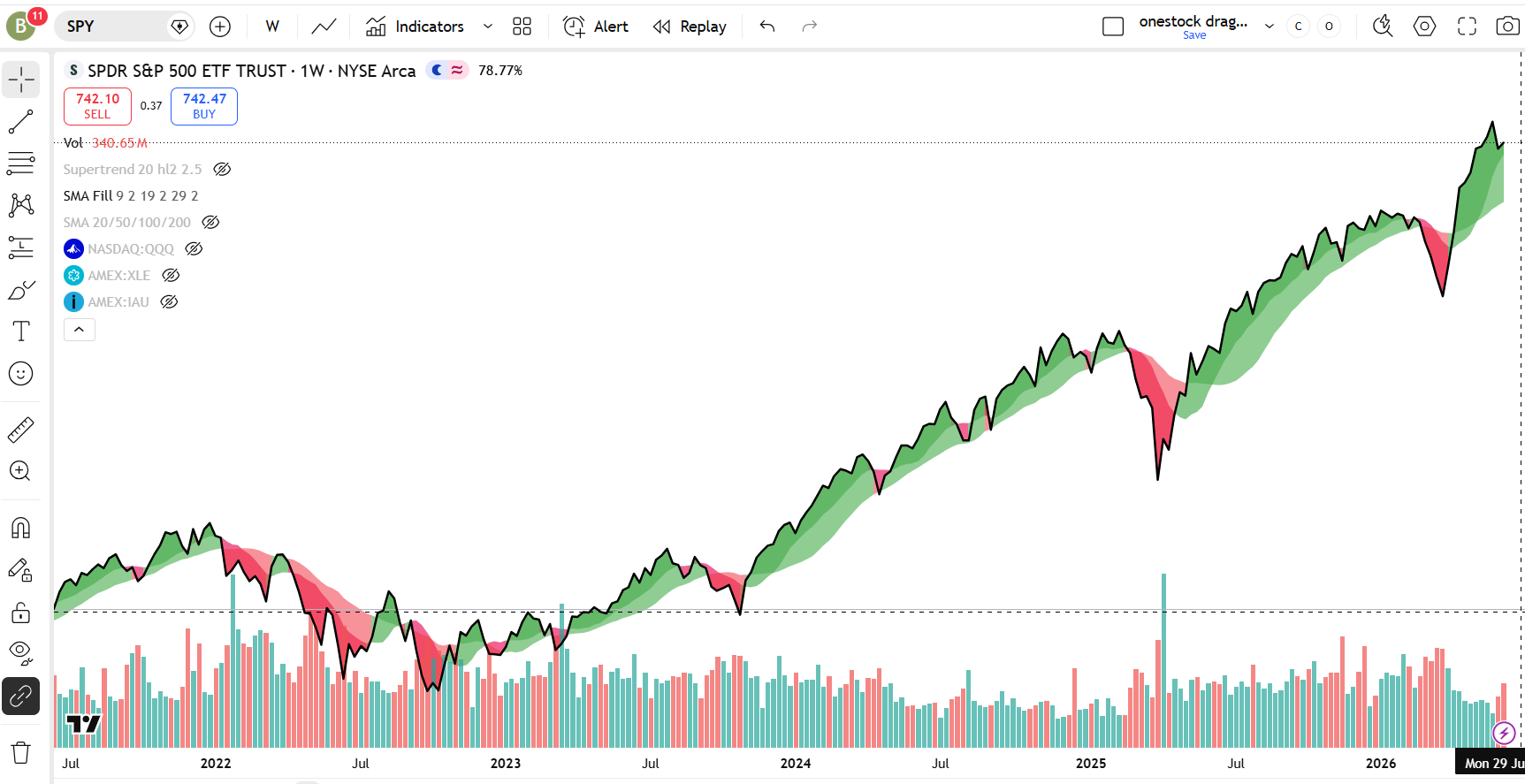
And it’s like the stock market (you knew that was going to come up, right?).
Sometimes you’re down. Sometimes you’re flat for so long you question everything.
You just want to be the S&P 500 of your own life: ugly in the short term, up and to the right over decades.
The loophole
Now, here’s where my brain found a loophole. I was fasting, so I decided that as long as I didn’t eat, everything else was fair game. This is the kind of deal you can only negotiate with yourself, because no one else would accept the terms.
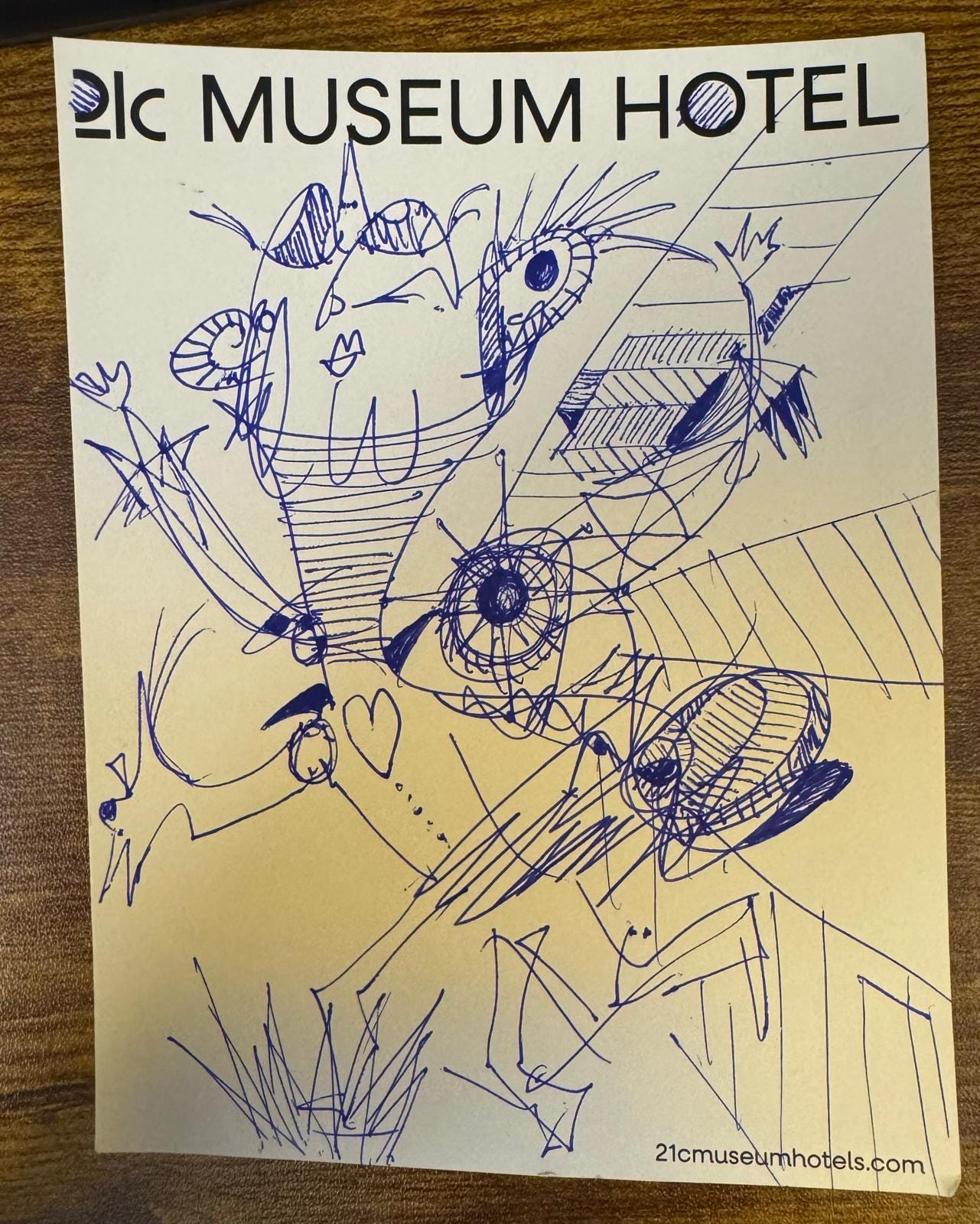
So between walks with my mom, I wrote jokes, made some art, listened to music, squinted at my grandfather’s handwritten sermons — he was a teacher, then a pastor, and his handwriting was apparently a third career in cryptography — and monitored the Spurs-Knicks game through Google’s little news updates, which is the least monastic sentence ever written.
And I mined stories. This is a part I’d copy, if I were you.
I’d been using AI to prompt me for personal stories, and the prompts kept whiffing. “Tell me about a time you showed resilience.”
I’d always draw a blank for some reason.
So we engineered a better formula. Three parts:
A period of your life (childhood, college, first job)
A feeling or an angle
One weirdly specific question
Examples:
Who’s the first person who ever made you feel like an outsider?
Who in your family did everybody tiptoe around?
Who’s the relative who was secretly the funny one?
Who’s a teacher in grade school who either believed in you or wrote you off?
Who’s the kid who bullied you — and what did they actually say?
Who’s the first person who made a whole room laugh and made you think “I want that”?
Who’s the adult you idolized as a kid until the day you saw them differently?
Who’s a neighbor or family friend who was just… strange, and you loved it?
Who’s the person who gave you your first real responsibility?
Who in your family said a sentence you’ve never been able to forget?
Those work instantly. Something surfaces every time. I pulled eight new stories out of one retreat.
Then the second pass, later:
Does the story tell you something new about you, or the people in it, or your life now?
Is there a principle a keynote can stand on?
And is there a joke in it — because fresh stories usually come out a little funny before you’ve sanded them down.
I’d argue that second pass is a spiritual practice too. Knowing your own stories is a form of knowing yourself. It just happens to also be billable and fun for others.
Aim past the target
The jokes I was trying to write that week were a specific kind.
There are very few comedians who can do this:
Get two or three laughs inside a single sentence. Not two sentences for one punchline. Laughs mid-sentence
Managing the audience’s expectations word by word as the sentence unfolds.
The old-school comedy standard was laughs per minute — ideally more laughing than talking. A lot of comics now will run a five-minute setup for one payoff, and look, that can be great storytelling, but it’s a different craft.
The multi-laugh sentence is brutally hard: three laughs in under thirty words, with no room to hide.
Here’s the useful part. This goes way beyond comedy. When I tried to write the nearly impossible sentences, I kept failing into a pile of merely good ones — clean one-laugh lines or two-sentence pairs I’d never have written if I’d aimed at them directly.
Attempting an absurd target makes the normally hard thing easy.
I think that’s true of most skills.
Aim past where you’re trying to land.
The voice recorder problem
I should confess something, though. Notice what I just described: I went on a spiritual retreat and came home with deliverables.
I always feel a little guilty being productive on retreat. Even on dark retreats — total darkness, four and six days, I’ve done both — I bring a voice recorder. Partly to fight the boredom, partly to stay cogent, because you can get genuinely lost in there. But partly because some piece of me cannot stand the thought of a good idea dying unrecorded. Oh no, the world will never benefit from this thing I mumbled in the dark on day three. Tragic. Alert the historians.
And if I’m honest about where that comes from: my drive to help people with my ideas has always been tangled up with ego and insecurity. “Let me prove I have great ideas. Let me prove I matter. Let me prove I’m better than most people.”
Standard-issue insecurity stuff, the kind a lot of us carry.
The uncomfortable part is that the proving instinct points the whole machine at me — and that’s exactly what keeps you from thinking clearly about how to actually be useful to the people in your life. The thing pretending to be generosity is sometimes just hunger with a podium.
Next dark retreat, the recorder stays home. The goal is to just be, lose the ideas, and survive the frustration. I give myself even odds.
A Fallow Feeling
Farmers have long known the wisdom of rotating crops.
When the land got tired, they let a field lie fallow for a season.
Nothing planted. Nothing harvested. On purpose.
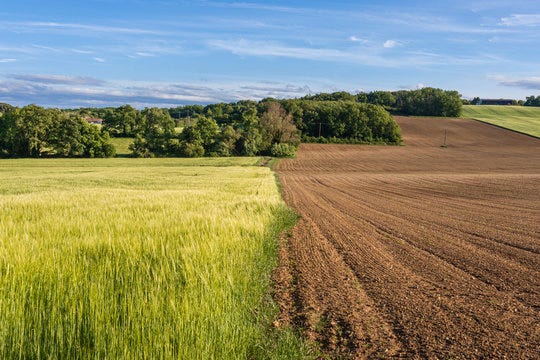
Most of us only rotate what we’re doing in our lives. New project, new platform, new skill — it feels like rest because it’s different, but it’s still input-output, input-output, all day, every day, as if the soil will never get tired.
But he soil gets tired. And the soul gets tired.
Fasting and retreat are fallow seasons for the body, brain, and soul.
Renewal.
And nature is part of it. My mom and I walked twice a day at Mepkin, and we talked about how she and my dad always valued being outside, and their parents before them, and how it passed down to me — the hiking, the climbing, the going into the woods in college just to sit there.
Humans spent something like a hundred thousand years living in nature. It’s natural for us to look at nature.
Staring at a forest is restorative the same way staring at a fire is, and probably for the same reason: we grew up with it, as a species.
A forest has a complexity no building has — try predicting the weather — and weirdly, that’s the relaxing part.
There’s nothing for the brain to grab onto. And our brains are grabbing onto things all the time.
Take a break.
So: schedule the difficult thing.
Expect two bad days.
Don’t try to time the grace.
And let the field go fallow once in a while.
Just maybe ask the monks to hide the cake first?! 🤣