
I Built a Comedy Writing Partner Out of Math. Then It Tried to Write This Article.
Creating with AI is like Building a House Out of Wet Sponges

I have a confession about this article.
The first draft opened with me standing on stage in Greenville, six minutes into a keynote, about to deliver a “cheesecake” bit. Eight hundred corporate leaders doing the macarena in their seats. Algorithmic precision meeting human instinct. Beautiful story.
Completely made up.
I mean, not by me. By the AI that drafted this article. It took one real detail from my actual comedy work... the macarena IS in my material... and built an entire fabricated keynote scene around it. Invented a city, invented an audience count, invented a three-day Google Books analysis that never happened.
(The analysis did, but it took 30 seconds.)
Lynda read it and said “When were you in Greenville?”
I wasn’t. AI lies.
So now I have a better article. Because the thing I actually want to tell you about AI and comedy writing? You just watched it happen.
Here’s what’s real.
I’ve spent the last few months in my spare time building a comedy writing system. Not a joke generator (those are terrible). A set of tools that do the math comedy requires but that human brains are bad at.
One tool maps word associations using a database of 100,000+ human free-association responses. When I feed it “neural plasticity,” it walks three hops out from the obvious associations and finds concepts that are genuinely distant. Not random. Distant in a specific, measurable way.
Another tool scores every joke I write against calibrated weights from my own rated history. Not “is this funny” (nobody can measure that). More like “does this have the structural features that correlated with laughs when I performed similar material.”
A third tool takes a finished chunk of 5-7 jokes and tests every possible ordering to find the best opener, the right energy arc, where to put the callback.
None of them write jokes. They do reconnaissance.
It’s a comedy writing partner.
---
Let me show you what that looks like in practice.
I needed a chunk for a keynote about change and adaptation. Neural plasticity, comfort zones, the usual corporate wellness territory. The topic every speaker gets asked about and every speaker handles the same way.
My old process: sit with a legal pad, write “neural plasticity” at the top, stare at it, hope something funny occurs to me about brain science. Maybe I land on something. More likely I get lost, get stuck, then get distracted.
And I’ve seen countless open mic comedians do the same 10 jokes they wrote in their first 3 months for 5 years. Stagnating.
The new process: I fed “change is accelerating, neural plasticity, adaptation as a skill” into the pipeline and let the tools work.
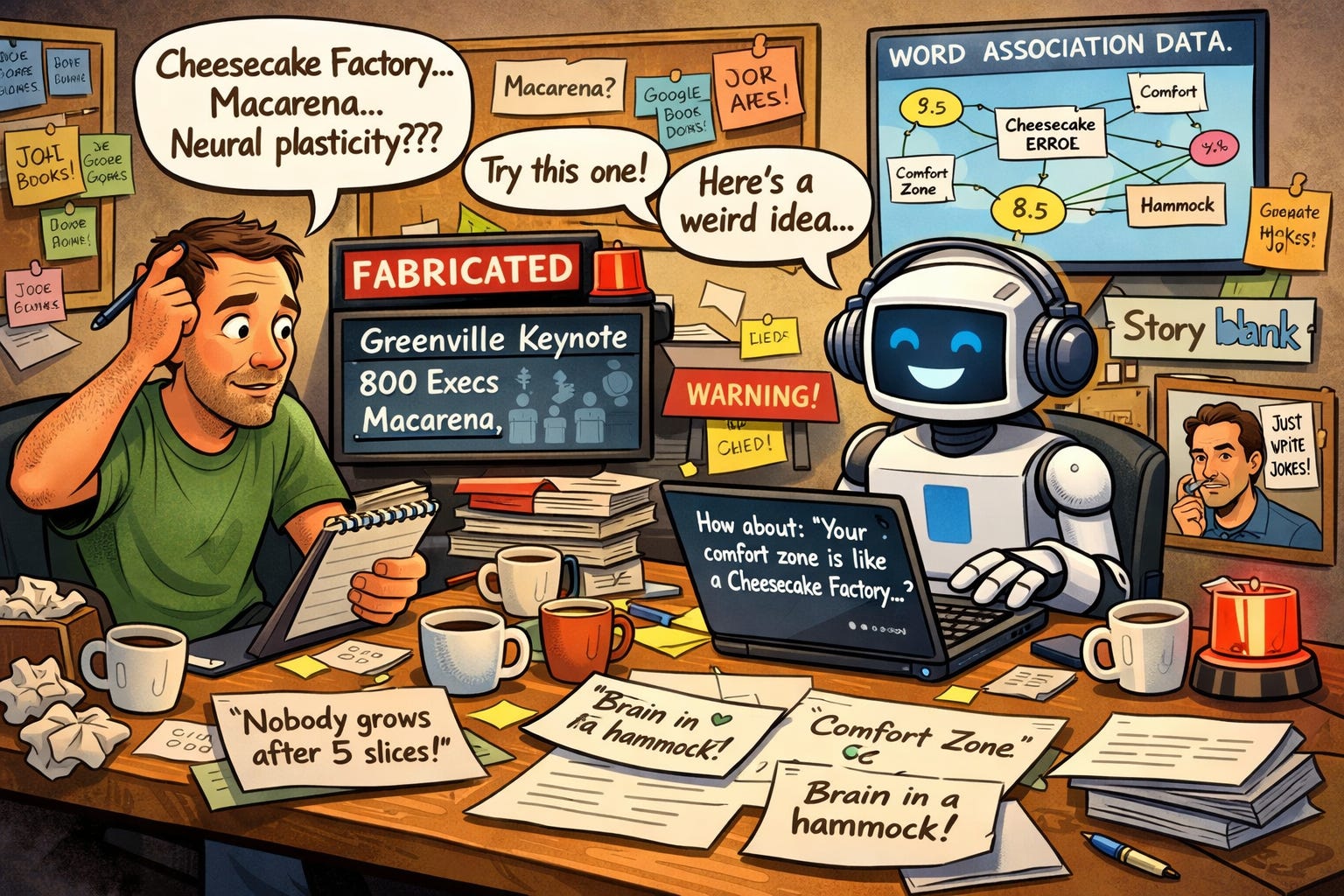
The system came back with a SWOW association walk that connected “comfort zone” to “Cheesecake Factory” at three hops. Not a connection I would have made sitting with my legal pad. But the moment I saw it, I knew.
"Small World of Words" (SWOW) is a large-scale, international research project and dataset focused on collecting word associations to understand the structure of the mental lexicon. It serves as a modern, comprehensive, and multilingual update to older word association norms, allowing researchers to study how words are connected in the human mind.
“Your comfort zone is literally a Cheesecake Factory. It’s all good, no surprises. But nobody leaves the Cheesecake Factory with the ability to make more money.”
That’s mine. The tools didn’t write it. They found the neighborhood. I built the house.
Then the tag: “Nobody ever grew from their fifth slice of cheesecake. Well... not UP.”
(Ok, that one’s a bit cliche, but it works.)
And from there the whole chunk opened up. The Cheesecake Factory became the running thread. The neural pathway is eating cheesecake in a hammock. Eventually it has a heart attack. Then (because I’m me) the macarena comes up.
Ten jokes in the chunk. The tools generated maybe 30 raw angles. I used zero of them verbatim. But I used the directions they pointed.
---
Here’s the part that’s hard to explain without sounding like I’m selling something.
I’ve been writing comedy for twenty years. I know how to find angles. I know what’s fresh and what’s been done. But I also know what it feels like when your brain gets stuck... when every angle you generate feels like a slightly different version of the same joke you’ve already heard- or just isn’t funny.
The tools break that pattern because they’re not pattern-matching the way my brain does. SWOW doesn’t know what’s funny. GloVe vectors don’t understand timing.
GloVe is an unsupervised learning algorithm for obtaining vector representations for words. Training is performed on aggregated global word-word co-occurrence statistics from a corpus, and the resulting representations showcase interesting linear substructures of the word vector space.
An n-gram novelty scorer is a natural language processing (NLP) metric designed to evaluate the originality of text generated by Large Language Models (LLMs) by measuring how many n-grams (sequences of items) in the generated text did not appear in the model’s training data. It helps quantify whether an AI is creating new content or merely reciting passages from its training set.
The n-gram novelty scorer has no sense of humor whatsoever.
That’s the point.
Sometimes I come up with a weird connection naturally. Maybe once a week. When I want to write on command, my brain wants to go to the obvious connection. Not as useful.
“Neural plasticity” plus “old dogs new tricks.” Meh.
“OMG there’s plastic in my brain!” Ok, dude.
The tools show me “neural plasticity” plus “cheesecake” because mathematically, those concepts have very low co-occurrence in human association networks. My brain would never get there. Not because I’m not creative, but because my pattern-matching is doing exactly what pattern-matching does... finding patterns.
I add the Factory part, because that restaurant is ridiculously extreme. Very American of us. Unprovably bad for your health. (Well actually, there’s a lot of great research on that.)
For the jokes, the Cheesecake Factory isn’t a pattern. It’s an escape from patterns.
(I realize I’ve now written 400 words about the Cheesecake Factory and I haven’t had lunch. This is a problem. I’m going to go eat a stick of butter. Which is surprisingly ok.)
---
But here’s where it gets weird. And where this article earns its meta angle.
I asked the AI to draft this article about my comedy writing process. I gave it the real details... the tool names, the Cheesecake Factory bit, the macarena. I said “write a BtK article about how I cowrite comedy with AI.”
It came back with 1,800 words. Strong structure. The argument was sound (my adversarial agent approved it, which is saying something... that thing rejects everything).
But then it fabricated a keynote scene. Greenville. Eight hundred people. A coronary artery bit I’ve never performed. Three days of Google Books analysis that took 30 seconds, if that.
My fabrication checker caught it. The tool literally compared every personal claim in the draft against my indexed story bank and flagged: “FABRICATED: No matching story for Greenville keynote scene.”
So the AI that helps me find comedy angles also helps me catch the AI that helps me write articles about finding comedy angles- when it’s lying.
It’s lyINGCEPTION. I need a nap.
The point is: the fabrication is the lesson. AI is incredibly good at making things sound real. “Eight hundred corporate leaders in a Greenville ballroom” is vivid, specific, concrete... everything good writing is supposed to be. And none of it happened.
My tools caught it because they’re designed to. The story bank is a fabrication firewall. If the claim can’t be traced to something I actually lived, it gets flagged. (And anything it misses, I catch in the editing.)
Most people using AI for creative work don’t have that firewall. Which means most AI-assisted creative work has fabricated details that sound real, read real, and aren’t real.
---
I keep thinking about what my friend Dave would say. Dave does corporate comedy. Clean stuff, conference humor, the kind of material where you need to land every single joke because the CEO is watching.
Dave would say: “So you built a system that generates directions you don’t use, catches lies from other AI that you also built, and the actual comedy comes from... you sitting at your desk writing jokes. How is this different from just writing jokes?”
Honestly? It’s faster. The Cheesecake Factory chunk took an hour. Similar material used to take me a week- or never happened. Not because I’m funnier now, but because I’m spending less time in the cul-de-sacs. The tools eliminated the dead ends before I walked into them.
And the material is stranger- in a good way. I would never have connected neural plasticity to the Cheesecake Factory on my own.
The tools found the gap. I decided the gap was worth filling. That’s the whole relationship.
---
This article you’re reading went through the same pipeline as my jokes. An excavator agent pulled out the core argument. An adversarial agent attacked it (”You built an elaborate system to avoid using any of its output... this is just expensive procrastination with a tech story”). A cartographer mapped what everyone else is saying about AI and creativity. An architect built a 6-beat logic chain. A ghostwriter drafted it. An editor checked for voice violations.
Then my wife asked when I was in Greenville and the whole thing collapsed.
And now you’re reading the version where I told you all of that, instead of pretending it went smoothly.
I think that’s the real lesson about AI and creative work. Not the telescope metaphor (though I still like it). Not the computational reconnaissance framing (though it’s accurate).
The real lesson: the AI will always try to make your story neater than it actually was. Your job is to keep it messy. Keep the part where it broke. Keep the part where your wife caught the lie.
That’s where the comedy lives anyway.
Head check: When was the last time you let the messy version be the final version?
Heart check: What would you make if you trusted the weird connection instead of the obvious one?
Gut check: What’s your Cheesecake Factory... the thing so mathematically unexpected that your pattern-matching brain would never find it on its own?
I don’t know, actually. I’m still figuring this out.
But the Cheesecake Factory bit kills.
And I never would have found it staring at a legal pad.